Your Energy Management Dashboard: A Practical System for the Feminine CEO
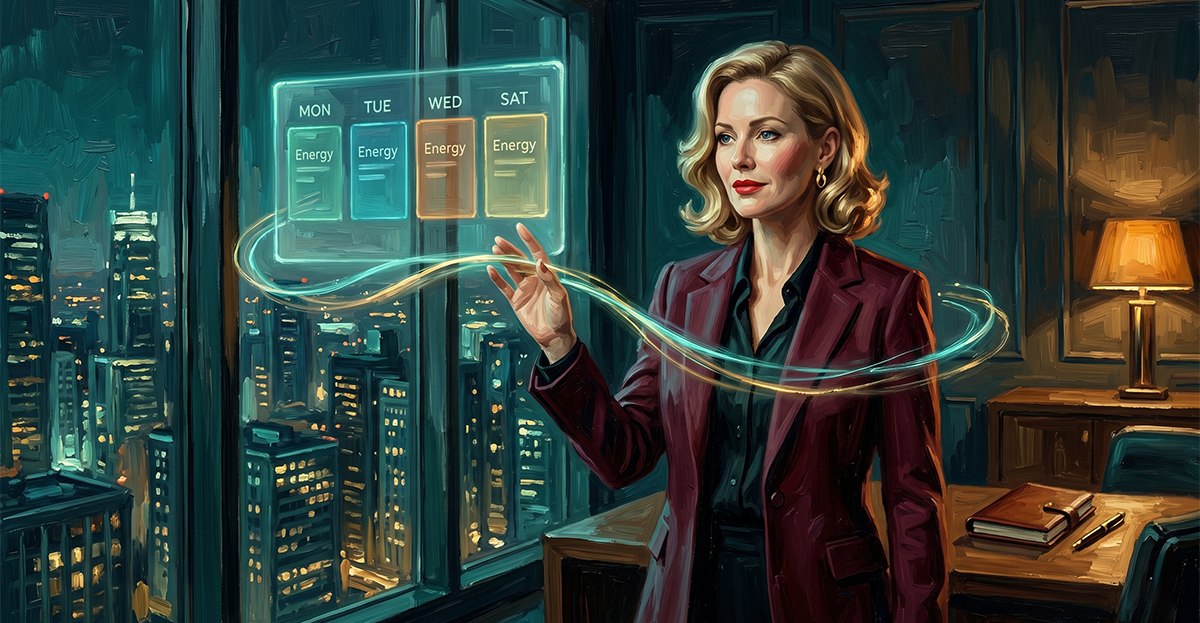
If you read Tuesday's piece on energy architecture, you already have the inner foundation. You know that your energy moves through four distinct states, that creative work and administrative work require completely different cognitive and energetic resources and that the flat calendar model has been costing you output quality for years without you knowing it.
This post is the structural companion. The implementation architecture that works best when that inner foundation is already in place.
What Tuesday explained, Thursday builds. By the end of this post you’ll have a complete, AI-supported energy management system you can begin using this week. Not a concept, a dashboard.
Why Most Planning Systems Fail the Feminine CEO
Before we build anything, it’s worth understanding why the standard approaches keep falling short.
Most planning systems are task-first. You open your planner, write down what needs to happen and then you find a slot for each thing somewhere in the week. The assumption baked into this model is that you’re equally available for everything at every hour. You just need to decide what goes where.
But task-first planning ignores the most important variable in your entire operation. You.
A strategy session that requires creative energy is not the same as returning emails. A discovery call that needs your warmth and full presence is not the same as updating your project management system. And if both of those things are sitting back to back in your calendar without any consideration for what state you're in when you arrive at them, you’re not managing your business. You’re just moving through it.
The energy management system for entrepreneurs that actually works is energy-first. It starts not with what needs to happen but with when you’re most capable of which kind of work. Then the tasks get placed inside a structure that was already built around your capacity.
This is not a complicated shift but it is a foundational one. And once you make it, task-first planning starts to feel almost comically backwards.
The Energy Audit: Know Your Pattern Before You Build Your System
You can’t build an energy-aware schedule without data and the data you need is not in any app. It’s in a week of honest self-observation.
This is the first phase of your energy management dashboard and it’s the only one that requires no technology at all.
Phase 1: The Seven-Day Energy Map
For one week, track your energy three times a day. Morning, midday and late afternoon. At each check-in, note two things.
First, your energy state. Use the four categories from Tuesday: Creative and Generative, Social and Relational, Focused and Analytical, or Reflective and Integrative. Just note what’s actually present, not what you wish were present.
Second, your energy quality. A simple one-to-ten scale works fine. Not how productive you were but how resourced you felt.
Do this without judgment. You’re not looking for a pattern you like. You’re looking for the pattern that’s actually there.
By day five or six, it will start to become obvious. Many women find they have a clear creative peak in the late morning, a social availability window in the mid-morning or early afternoon, an analytical capacity window in the early to mid afternoon and a reflective pull in the late afternoon and evening. But your specific version of that is yours. Track it and find out.
This map is the foundation everything else is built on. Do not skip it.
Building Your Energy Architecture Calendar
Once you have your map, you can build the structure. This is where your weekly planning shifts from reactive to intentional.
Phase 2: The Architecture Layer
Open your calendar and create four recurring blocks each week. These are not tasks, they’re energy zone placeholders. Color-code them differently from your meetings and deliverables.
Creative Zone: your peak creative hours, protected. This is where your most generative work lives. Writing, strategy, offer development, content creation. Two to three hours maximum. Don’t schedule anything relational or administrative here.
Social Zone: your warm and present hours. Discovery calls, client sessions, team collaboration, podcast recordings, community time. This is connection work and it needs you genuinely available, not just technically present.
Focused Zone: your analytical hours. Email, admin, scheduling, finance review, systems maintenance. This work needs attention, not voltage. It fits naturally into the quieter part of your day.
Reflective Zone: protected rest and integration time. This is not lunch at your desk. This is genuine space for your nervous system to process, your subconscious to work and your creative well to refill. Even thirty minutes of real rest in your reflective window changes the quality of everything that follows.
Once these four zones are visible on your calendar, you have your architecture. Now tasks go inside zones that match them, not into whatever happened to be open.
AI Tools That Make This System Effortless
Here’s the honest truth about energy-aware planning: it’s not hard, but it does require consistent attention. And consistent attention is exactly where AI tools earn their place in a feminine CEO's ecosystem.
You set the strategy, they hold the structure.
Reclaim.ai is the workhorse of this system. Connect it to your Google Calendar and use it to set your four energy zone blocks as protected habits. Reclaim will defend them automatically. When a meeting request comes in that would eat your Creative Zone, Reclaim reschedules your habit block to the nearest available protected window instead of just letting it disappear. You can also tell it your preferred working hours, buffer time preferences and focus session length, and it manages all of that in the background without you touching it again.
To set this up: connect Reclaim to your Google Calendar, create your four energy zones as recurring habits with your preferred times and durations, set their priority level to high and turn on the auto-scheduling feature. It takes about twenty minutes once and saves that time every single week after.
Motion goes one step further. Where Reclaim protects your structure, Motion builds your daily task list dynamically based on your workload, deadlines and your energy windows. You input your tasks and their priorities. Motion decides when they happen based on what kind of work they are and when you have the right capacity available. If something takes longer than expected, it automatically rebuilds the rest of the day around the new reality. It’s particularly useful during high-volume weeks when you have more tasks than you have easy mental real estate to manage them manually.
Claude is where the strategic layer lives. Unlike Reclaim and Motion, which are schedulers, Claude is a thinking partner. Use it at the start of every week for your weekly energy planning session. Here’s the prompt structure that works:
"I want to plan this week with my energy in mind. My energy pattern is: [describe your map from Phase 1 — peak creative hours, social window, focused window, reflective time]. My four energy zones this week are blocked as follows: [paste your calendar structure]. Here are my tasks and priorities for the week: [list them]. Please assign each task to the most appropriate energy zone and explain your reasoning. Flag anything that feels mismatched."
Claude will read your task list against your energy map and give you an initial placement that you can accept, adjust or question. It takes the decision-making weight off your brain before the week even begins. Then you adjust for anything it missed, set your calendar and start Monday from a position of structural clarity rather than reactive planning.
A note on what AI does and does not do in this system. These tools do not make decisions for you. They hold complexity, protect structure and reduce the mental load of planning so you can bring your actual intelligence to the work rather than spending it on logistics. You’re still the architect, they’re the general contractor who keeps the build on schedule.
The Weekly Energy Planning Ritual
A system is only as good as the ritual that activates it. Here is the complete weekly flow.
The Energy Architecture Weekly Ritual
Sunday evening or Monday morning, 20 minutes maximum
Step 1: Check your four energy zones. Are they still protected in the calendar or did something sneak in over the week and claim one of them? Restore anything that moved.
Step 2: Open Claude. Paste your weekly task list and your energy map. Run the planning prompt above. Read the output, adjust for anything that doesn't fit your intuition and note the final placement in your task manager.
Step 3: Set one creative priority for the week. This is the single most important piece of generative work you will do this week. It goes in your first Creative Zone of the week, before anything else.
Step 4: Name your reflective anchor. One thing you’ll do this week that genuinely replenishes you. A walk, a long lunch, an afternoon with no agenda. Put it in your Reflective Zone and treat it as non-negotiable.
That’s the complete ritual. Twenty minutes. Once a week. And the quality difference in how the week unfolds is not subtle.
The Complete Energy Management Dashboard
Here’s the full system in one place.
The Energy Architecture Dashboard
Layer 1: Your personal energy map (seven days of observation, four states, honest tracking)
Layer 2: Your four calendar zones (Creative, Social, Focused, Reflective: color-coded, recurring, protected)
Layer 3: Your AI support stack (Reclaim.ai holding the structure, Motion managing task flow on complex weeks, Claude doing your Monday morning planning session)
Layer 4: Your weekly ritual (20 minutes, four steps, every Monday morning without exception)
Each layer works on its own. All four together create what I think of as a truly elegant operating system. One that treats you as the primary variable in your business rather than the person who just shows up and tries hard.
Closing Bridge
The inner work is understanding what energy architecture is and why it matters. That lives in Tuesday's companion post. The outer work is building the system that makes it real in your actual week. That’s what you have here.
A feminine CEO who knows her energy pattern, protects her best hours and uses AI to hold the structure she designed, is not just more productive. She’s more creative, more present, more strategic and significantly less tired. Not because she’s doing less, because she’s doing the right things when she’s actually capable of doing them brilliantly.
The Energy Architecture Workbook in this week's Plus issue goes further still. Inside is a personal energy audit guide, a 21-day daily calibration practice and the complete Claude planning prompt fully built out with a fill-in-the-blank template you personalize once and use every week after. If this post gave you the system, the workbook gives you the daily practice that makes it stick.
Related Reading
